



Enhancing Patient Care Through Healthcare Business Intelligence
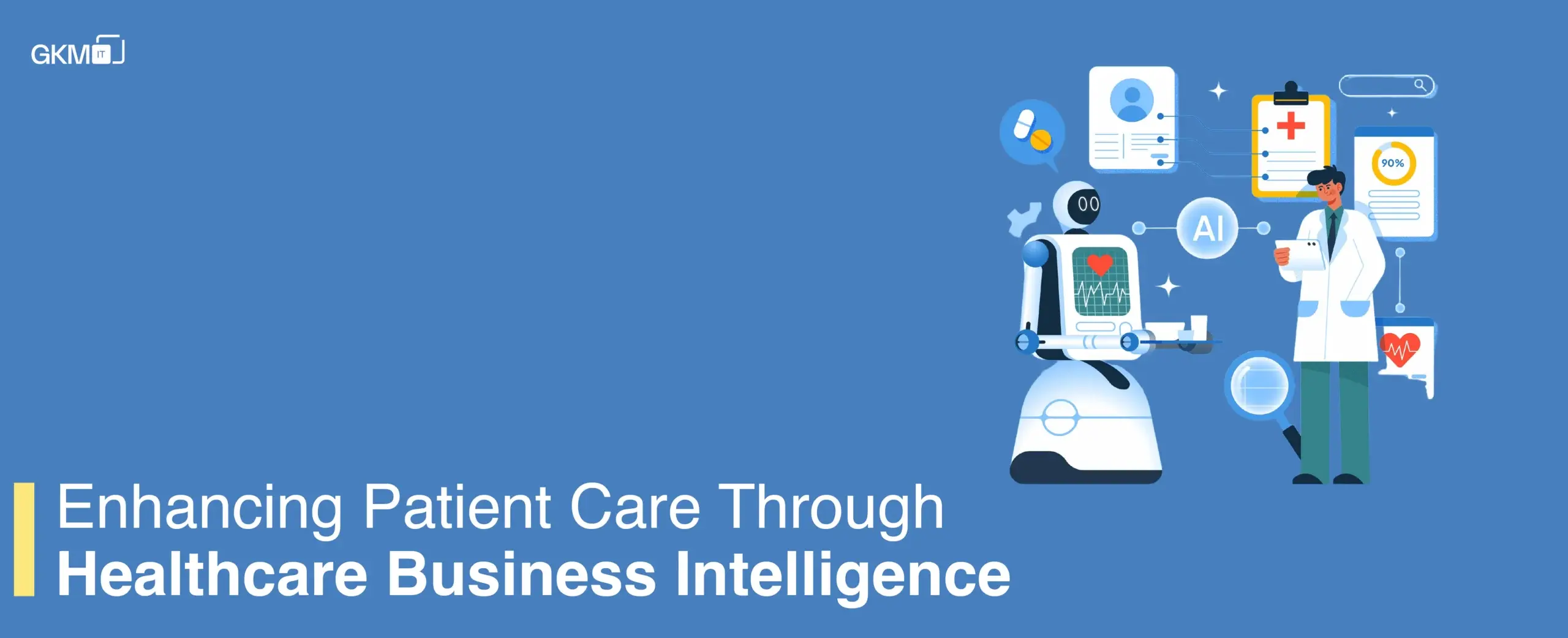
The healthcare industry is undergoing a transformative shift driven by the integration of technology and data-driven decision-making. Business Intelligence (BI) is a vital tool in this transition, offering new solutions to enhance patient care, streamline operations, and overall improve healthcare delivery.
This blog examines how healthcare business intelligence tools and healthcare business intelligence system are shaping the industry, the role of healthcare software development services in enabling this transformation, and how BI improves patient care.
What is Business Intelligence in Healthcare Industry?
Business intelligence in healthcare industry is the application of data analytics, reporting tools, and systems to obtain, manipulate, and analyze healthcare data, thus allowing healthcare providers and administrators to make informed decisions, improve operational processes, and achieve better patient outcomes.
The essence of business intelligence in healthcare industry systems is derived from multiple data sources such as Electronic Health Records (EHRs), patient surveys, and performance metrics for evidence-based decision-making. These observations can allow companies to act in inducing cost savings, improving operational efficiency, and applying personalized treatments of patients as necessary.
Key Applications of Business Intelligence in Healthcare Industry
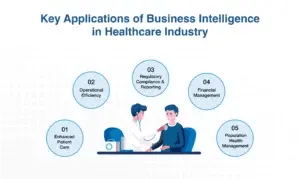
1. Enhanced patient care
One of the most critical contributions of healthcare business intelligence is its power to transform patient care. Through analysis of patient data, BI tools facilitate healthcare professionals' identification of patterns and trends, with the ability to provide an early and accurate diagnosis, customized treatment, and prevention.
For instance, predictive analytics, a branch of BI, may be used to predict patients' chances of developing chronic illnesses so they can be treated proactively. Not only does this improve the outcome, but it also decreases the cost of treatment.
2. Operational Efficiency
In the area of commercial health business intelligence systems, hospital operations are improved by clinical decision support systems by analyzing essential metrics such as bed occupancy, patient wait time, and workforce time. Real-time dashboards directly assist the administrator in understanding the use of the resource, and they can be used to correct bottlenecks and improve workflow efficiency.
3. Regulatory Compliance and Reporting
It becomes very powerful for BI tools to generate automated reports that are in compliance with very stringent healthcare requirements. Based on insights regarding patient safety, billing practices, and quality metrics, it helps organizations ensure compliance and focus on delivery.
4. Financial Management
Business intelligence for the health system allows for effective tracking and management of costs without compromising patient care quality. BI tools can identify where costs can be cut by analyzing billing data, expenditure trends, and revenue cycles.
5. Population Health Management
BI solutions collect data on populations of people and analyze health patterns and high-risk groups. This will help healthcare institutions develop specific intervention plans for improving community health outcomes and reducing health system burdens overall.
The Role of Business Intelligence Software in Healthcare
Customized business intelligence software in Healthcare are vital engine in actualizing business intelligence in healthcare. They are the answer for healthcare organizations to engineer customized solutions aligned with their existing systems and address specific problems.
Some Important Contributions Include:
- Data Integration
Custom solutions unify various sources of data into one integrated BI system, such as EHRs, lab systems, and patient feedback platforms. - Scalability
Software Development Services will let BI tools grow as the organization grows and changes needs. - Security
Custom-based BI solutions have advanced security features to prevent unauthorized use of sensitive patient data. - Easy-to-Use Interfaces
Custom interfaces that make it very easy for healthcare practitioners to access and understand BI inflows.
Role of Healthcare Business Intelligence in Patient Care
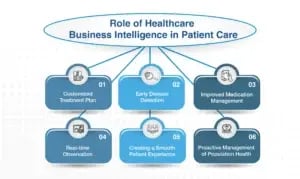
Customized Treatment Plan
With the help of health BI systems, a patient's medical history and genetic history can be associated with current health conditions to create personalized treatment plans. Personalization could bring about an increase in the outcome of the treatment, as well as the level of satisfaction of the patient.
Early Disease Detection
By applying some predictive analytics within BI to analyze risk factors and symptoms of diseases, they could be detected at an early stage. For instance, concerning lab results, one may check how the trends are going to develop to pre-diagnose diabetes or cardiovascular diseases before they become serious.
Improved Medication Management
The Business Intelligence application in health care is a system that manages medications very precisely, tracking prescriptions, dosages, and adherence by patients. It results in less error and increased patient safety while making treatments much more effective.
Real-time Observation
Real-time analysis lets the healthcare provider view the patient's vitals and be alerted if anything goes wrong. This improves access to care, particularly in rural areas, and reduces hospital visits for non-critical conditions.
Creating a Smooth Patient Experience
Business Intelligence tools derive insights that help identify the bottlenecks on a patient's journey, and that assessment allows the healthcare providers to work on changing or improving appointment scheduling, reducing waiting time, enhancing patient satisfaction, and more.
Proactive Management of Population Health
Systems of Business intelligence in patient care will interpret the data of a population to provide health trends within populations and possible future healthcare needs. In such a manner, hospitals and healthcare professionals will plan the resources needed to manage populations while lowering the strain on healthcare systems and improving the overall care for patients.
Challenges and Future Opportunities of Healthcare Intelligence
Issues:
-
Privacy and Security of Data
Protecting sensitive patient data remains unparalleled due to the heavy reliance on encryption and HIPAA-compliance protocols. -
Integration Problems
Most health organizations will have problems integrating their BI tools with the old legacy systems. -
Expenditure
The establishment and management of BI solutions usually do cost a significant amount as concerning especially for smaller health organizations.
Future Possibilities:
-
AI Integration
Business intelligence will be reinforced by artificial intelligence in its predictive prowess, as well as in automating routine work. -
Telemedicine and Remote Monitoring
BI will have significant input into data analysis coming into telehealth applications and wearable devices. -
Greater Visualization
Tools will offer greater intuitive and active visualization to convey insight to nontechnical users.
Conclusion
Revolutionizing almost every part of the industry, business intelligence and analytics in healthcare practice are digitally transforming decision-making power from clinical staff to the patient, enhancing care, optimizing operations, and so much more. All together, from personalization to population health management, there is an infinite list of applications based on BI's influence.
Such business intelligence and analytics in healthcare solutions with advanced tools and custom software development services allow organizations to meet obstacles while ensuring compliance and security. The more technology becomes an everyday phenomenon in the healthcare sector, the more this BI's role will be in an even more caring, proactive future.
At GKM IT, we provide healthcare software development and BI solutions specifically tailored to your organization. For more information on how we can help make sense of business intelligence in healthcare, please contact us now.
Related Blogs:
Generative AI in Telehealth: Enhancing Telemedicine and Patient Care
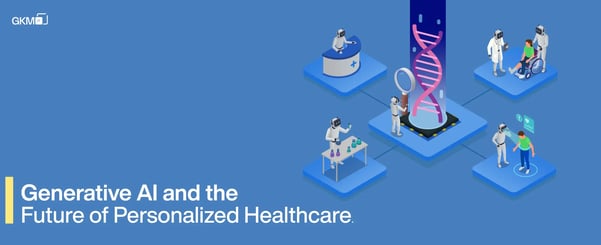
Generative AI and the Future of Personalized Healthcare
Adoption of Generative AI in Healthcare Systems
The Key Differences Between Javascript And Python
Frequently Asked Questions
1. How can BI reduce healthcare costs without compromising patient care quality?
Healthcare Business Intelligence solutions reduces costs through optimizing resource allocation, detecting inefficiencies, and enabling a data-driven decision process. Predictive analytics help avoid costly complications by proactively identifying high-risk patients. BI tools automate administrative duties first, thereby lowering operational costs and streamlining workflows.
Real-time monitoring allows for improvement in the efficiency of both staff and equipment, preventing over stretches of the budget. Patient data analysis ensures accurate diagnoses and treatment, further minimizing errors and readmissions. BI tracks trends in drug usage and inventory to minimize waste. BI facilitates a cost-effective environment with continued patient care through increased efficiency and targeted resources directed toward patient-centered care.
2. How does BI assist in early disease detection and prevention?
Business intelligence assists with early disease discovery and prevention through data analytic patterns in patient clinical records, lab results, and demographic information identification. The predictive analysis found in BI tools can cause the identification of risk factors for chronic diseases or epidemic outbreaks through historical data and real-time inputs. This allows for a proactive intervening nature of health industry practitioners through preventive measures like targeted screening or lifestyle suggestions. BI also assists population health management by identifying the groups at risk that can assist in early diagnosis and decrease disease progress from the proposed control measures. This approach, which is essentially data-oriented, is seen to improve patient outcomes and reduce the economic burdens affecting health.
Implementing business intelligence (BI) in hospitals requires a balance between maintaining patient privacy and optimizing operational efficiency. By integrating secure data management practices and adhering to regulatory standards, hospitals can leverage BI tools effectively while safeguarding sensitive information.
- Data Encryption: Ensure all patient data is encrypted, both in transitioning and resting, finally protecting the patient’s privacy.
- Access Control: Role assignment and control to prevent unauthorized access and modification of sensitive data.
- Compliance with Regulations: Current regulations concerning the protection of healthcare data established by HIPAA must be adhered to to ensure compliance.
- Training of employees: Train members of the staff on a regular basis in methods concerning data privacy and security-handled information.
- Efficient Data Management: Utilizing BI tools that automatically collect and analyze data minimizes human errors and is more efficient.
- Regular Audits: Regular security audits provide awareness of vulnerabilities to sustain data protection.
4. What is healthcare business intelligence?
Healthcare Business Intelligence (BI) uses technology, data analysis tools, and software to capture, process, and analyze healthcare data. It provides the ability to make informed decisions by turning raw data into meaningful insights
In the healthcare BI scope, patient outcomes can be tracked, hospital operations can be managed, clinical decision-making can be improved, and costs can be optimized. Providers can recognize trends and predict health risks enabling personalized treatment plans to be built up. The BI helps provide easy-to-understand and actionable insights, improving care quality, operational efficiency, and patient satisfaction, culminating in better healthcare outcomes and streamlined operations.



























-11.webp?height=245&name=Blog(%20The%20Magic%20of%20Reading)-11.webp)



-1.png?height=245&name=image%20(14)-1.png)







.webp?height=245&name=Library1.1%20(1).webp)





.webp?height=245&name=Hands-on%20Learning%20to%20Revolutionize%20Core%20Education-09-09%20(1).webp)


%20_653%20X%20518%20_%202%20copy%206.webp?height=245&name=Blog%20images(Empowering%20Young%20Innovators)%20_653%20X%20518%20_%202%20copy%206.webp)










.webp?height=245&name=smart%20learning-16%20(2).webp)


.webp?height=245&name=celebrating-the-incredible-staff-at-ocasa-01%20(1).webp)





.webp?height=245&name=mothers%20day-18%20(1).webp)
















.webp?height=245&name=Main%20Banner@2x%20(1).webp)