



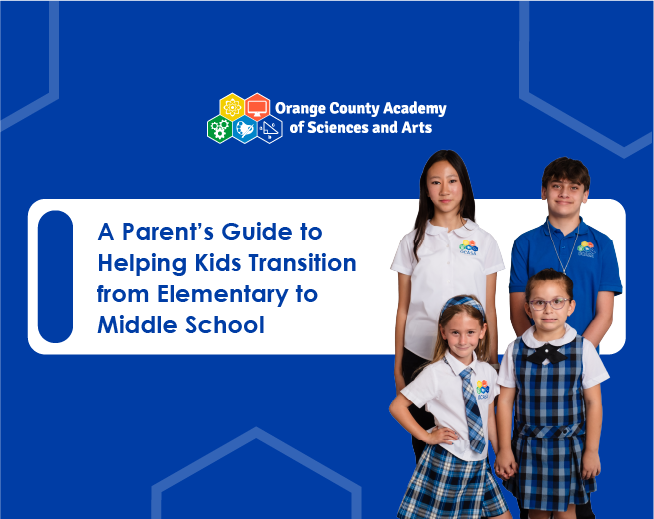
A Parent’s Guide to Helping Kids Transition from Elementary to Middle School
“Change can feel big, but with the right support, it becomes a chance to grow.”
The move from elementary to middle school is one of the biggest changes in a child’s school journey. It’s exciting, a little tense, but full of new adventures. It’s a time when kids start learning how to be more independent, all while still needing a lot of support and encouragement.
At OCASA, we believe that transitions like these are big moments worth celebrating. With the right support, a few helpful tips, and open communication, this shift can be a wonderful chance for your child to grow, learn, and shine in new ways. In this blog, we’ll explore what’s changing, what your child might be feeling, and how you, as a parent, can help them feel ready and confident for this next big step.
Things That Change During the Elementary to Middle School Transition
Middle school brings a lot of new things to students. For many kids, this might be the first time they’ll have multiple new subjects and move between different new topics. There may also be new classmates and more choices when it comes to clubs and activities. All of this can feel like a lot, especially at first.
For example, in elementary school, days often followed a steady rhythm: fewer lessons, familiar faces, and activities that were carefully paced. As students enter middle school, their day begins to open up. They explore new skills, get along with more varied learning experiences, and take part in bigger collaborative projects. This shift can feel exciting and a little unfamiliar at the same time, but it gives students a chance to lead, to adapt, and to grow stronger in both confidence and independence.
How Can Parents Support the Elementary to Middle School Transition
To support kids moving to middle school, parents can offer guidance in quiet but powerful ways. Whether it’s encouraging their curiosity or helping them feel more at ease with change, your involvement helps them feel more confident in handling what’s coming next.
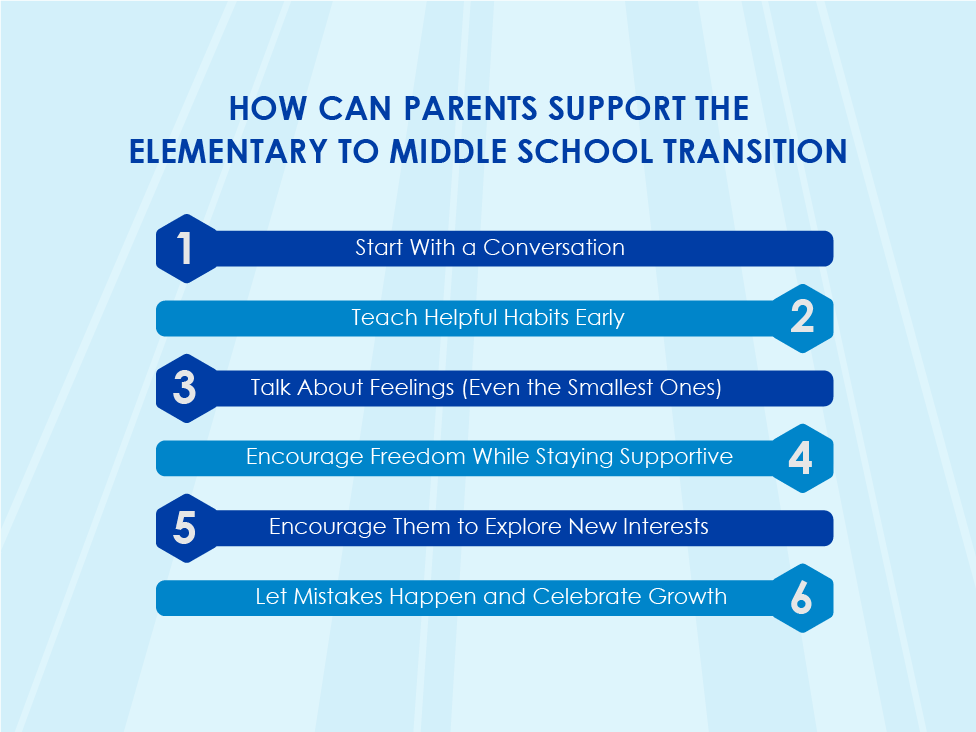
1. Start With a Conversation
Kids don’t always ask the questions they’re thinking, but that doesn’t mean they are not wondering. So it’s helpful to talk about the elementary to middle school change early. You might ask, “What do you think middle school will be like?” Or say, “I remember my first day of middle school. I got lost on the way to math class, but by the second week, I knew my way around.”
Stories like that can go a long way in helping your child feel less alone in their feelings. Be honest and stay positive; this way parents can reassure their child that feeling nervous is completely normal and that they’ll be there to help them along the way.
2. Teach Helpful Habits Early
During the middle school transition, kids have to be a little more organized than before. That’s why you need to start building those habits among children even before the school year begins. To do so, you can:
-
Practice using a planner or calendar:
You can begin with letting kids write down their everyday activities. Even something simple like tracking family events on a kitchen calendar can be a great start. -
Let them take charge of small tasks:
Let them pack their own backpack or manage their outfit for school. These small moments of independence help build confidence.
3. Talk About Feelings (Even the Smallest Ones)
It’s normal for kids to feel a mix of emotions about starting middle school. One minute they might be excited about all the new opportunities, and the next they might feel unsure about fitting in. If your child says something like, “What if I don’t know anyone in my classes?” You should reassure him/her by responding, “That’s a really common feeling. Want to talk about some ways you could say hi and get along with someone new?”
Being heard and understood helps children feel safe. And when kids feel safe, they are more likely to take healthy risks, like connecting with others and trying new things.
4. Encourage Freedom While Staying Supportive
As your child experiences the elementary to middle school change, they will want a little more independence, but that doesn’t mean you need to step back completely. Staying connected is still important, just in new ways. For that, you can ask how their day went and listen to them, help them solve their problems on their own instead of fixing everything, and most importantly, be present at their school events and let your child see that you’re part of their school world too.
For instance, if your child says, “I want to practice my class presentation on my own first.” You can respond with something like, “Of course. I’ll be right here if you want an audience afterward.”
This way, you can trust and respect their process while showing continued support.
5. Encourage Them to Explore New Interests
Middle school transition opens doors to lots of exciting opportunities. From robotics clubs to student council, sports teams to music groups, there’s something for every interest. If your child feels unsure about trying something new, remind them it’s okay to just show up once and see what it’s like.
For example, you can reassure your kids by saying, “You don’t have to sign up for the whole year. Let’s just go to the first art club meeting and see if you like it.” Encouraging them to try new things will build their confidence, and finding something they love will make their school days even more fun.
6. Let Mistakes Happen and Celebrate Growth
No one gets it all right on the first try, and that’s more than okay. In fact, learning from mistakes is one of the most important parts of growing up. If your child says something like, “Our project didn’t turn out the way we expected,” you might respond, “That sounds like a great discovery. What did you learn from the process?”
For a successful middle school transition, we should guide kids to understand that mistakes are not errors but rather opportunities for learning to bounce back, solve problems, and trust themselves. Celebrate their effort, not just the outcome.
How OCASA Supports the Elementary to Middle School Transition
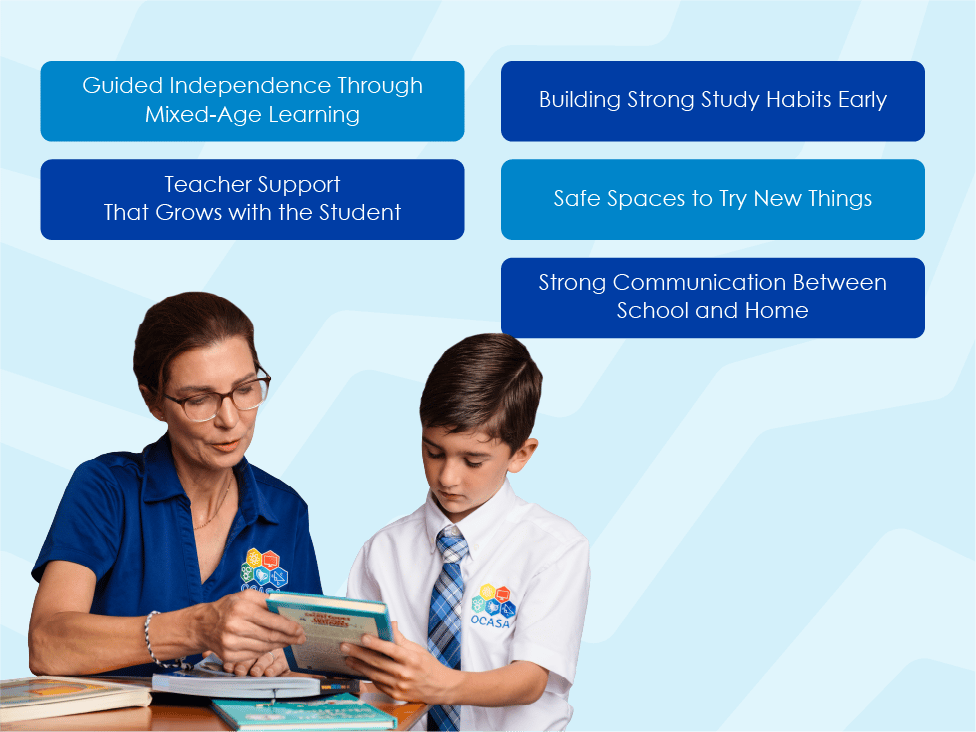
At OCASA, we know that moving from elementary to middle school can feel like stepping into a whole new world. That’s why we focus on creating a bridge that helps students feel confident, prepared, and supported from day one. Here’s how we guide our students through this important time:
-
Guided Independence Through Mixed-Age Learning
In our mixed-age classrooms, students naturally learn to lead and follow. Younger students see what’s ahead, and older ones build confidence by mentoring others. This exposure plays a critical role in helping a child transition to middle school, as such a gentle shift in roles helps prepare them for the independence expected in middle school.
-
Building Strong Study Habits Early
OCASA places strong emphasis on skill-building during the elementary school transition years. Students organize materials and manage hands-on projects through consistent routines in the elementary years. By the time they reach middle school, these habits are already in place.
-
Teacher Support That Grows with the Student
Our teachers understand that each child moves at their own pace. As students transition into higher grades, our teachers provide just the right balance of guidance and freedom, so kids can learn to speak up, ask for help, and advocate for themselves.
-
Safe Spaces to Try New Things
Through enrichment clubs and hands-on projects, students get to explore new interests in a supportive setting. These routines support helping a child transition to middle school, help them discover their strengths, and give them the confidence to participate in electives, clubs, or leadership roles in middle school.
-
Strong Communication Between School and Home
Supporting the elementary to middle school transition also means keeping families closely involved. Whether it’s meetings, progress updates, or check-ins, we make sure that families feel informed, supported, and connected throughout the middle school transition, reinforcing a sense of stability for students.
At OCASA, our goal is not just to prepare students for middle school but to help them walk in with confidence, curiosity, and a strong sense of who they are. The path may be new, but they’ll never walk it alone. This structure helps normalize growth and responsibility, making the elementary to middle school transition feel familiar rather than overwhelming.
Conclusion
The transition to middle school is a big step, but it’s also a beautiful one. With patience, practice, and plenty of love, your child will grow into this next chapter with confidence and curiosity. At OCASA, we’re proud to walk this journey with families every day. And remember, your support means everything. Just by showing up, listening, and cheering them on, you’re already helping your child feel ready for all that’s ahead. So go ahead and ask, “How was your day?” It’s a simple question that opens up the door to connection, growth, and successful middle school transition. Once you start imagining your child in middle school, learning how to apply can be a helpful next step. Our application guide breaks it down in a simple and family-friendly way.





.webp?height=245&name=Main%20Banner@2x%20(1).webp)


.webp?height=245&name=mothers%20day-18%20(1).webp)
.webp?height=245&name=smart%20learning-16%20(2).webp)

.webp?height=245&name=celebrating-the-incredible-staff-at-ocasa-01%20(1).webp)
%20_653%20X%20518%20_%202%20copy%206.webp?height=245&name=Blog%20images(Empowering%20Young%20Innovators)%20_653%20X%20518%20_%202%20copy%206.webp)
-11.webp?height=245&name=Blog(%20The%20Magic%20of%20Reading)-11.webp)






.webp?height=245&name=What%20Does%20Student-Centered%20Learning@2x%20(1).webp)


.webp?height=245&name=Hands-on%20Learning%20to%20Revolutionize%20Core%20Education-09-09%20(1).webp)



.webp?height=245&name=Library1.1%20(1).webp)
-1.png?height=245&name=image%20(14)-1.png)