




C# vs Java: Choosing the Right Language for Your Next Project
Choosing between C# and Java is more than a technical decision. It directly impacts performance, scalability, and long-term maintenance of the entire lifecycle of a software ecosystem. Both languages power thousands of enterprise systems worldwide, making the choice between them a strategic technology decision for many organizations.
If you’re reading this, you’re likely asking– “Which language is right for my next project?” or even debating Java vs C# – which is better? Let’s explore the key differences between Java and C# and gain a better understanding to answer this logically.
The Origins of C# and Java: Same Goal, Different Paths
C# and Java are similar in many aspects. They are both object-oriented languages, statically typed and designed with cross-platform development in mind.
Java is an older language, developed by Sun Microsystems (now owned by Oracle) and has the tagline, "write once, run anywhere." Microsoft later introduced C#, designed to run within the .NET ecosystem and is intended as a modern, open language, optimized for the Windows platform.
Over time, both languages matured into major ecosystems. Java became the dominant language for enterprise backend development and Android programming, while C# emerged as the leading language for Windows and game development, especially through its strong association with Unity.
Understanding how these ecosystems evolved helps explain the practical differences between the two languages today.
Key Differences Between C# and Java: Breaking Down the Core
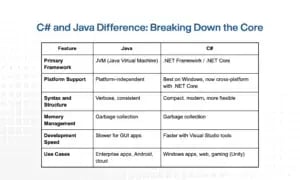
The core C# and Java difference stems from the ecosystems built around each language. Java favors portability and simplicity, while C# leans toward productivity and integration.
- Platform Ecosystem: Java focuses on cross-platform compatibility through the JVM, while C# integrates tightly with the .NET ecosystem.
- Development Environment: C# benefits from tools like Visual Studio, while Java developers often use IntelliJ IDEA or Eclipse.
- Primary Use Cases: Java dominates enterprise backend and Android development, while C# excels in Windows applications and game development.
Java vs C# Performance Comparison
When it comes to performance, the gap between Java and C# has narrowed significantly over time. Both languages use Just-In-Time (JIT) compilation, which compiles frequently used code paths into machine code during execution to improve runtime performance.
The Architecture of Speed
While their compilation methods are similar, their optimization strategies differ based on their underlying design philosophies:
- Java (The JVM Advantage): The Java Virtual Machine (JVM) is a masterpiece of adaptive optimization. It excels in long-running, high-throughput environments. Because the JVM "profiles" code as it runs, it can aggressively optimize frequently executed paths (HotSpots) over time, making it a powerhouse for large-scale distributed systems and big data processing.
- C# (The Hardware Synergy): C# gains its edge through tighter integration with the operating system, particularly on Windows. Features like Value Types and Span<T> allow developers more granular control over memory allocation and layout. This reduces garbage collection overhead in memory-sensitive applications, which is why C# is often preferred for high-performance gaming (via Unity) and low-latency desktop software.
Choosing Your Engine
Ultimately, raw execution speed is rarely the bottleneck in modern development; the "winner" is determined by your deployment target:
| Feature | Java | C# (.NET) |
| Primary Strength | Throughput & Scalability | Memory Efficiency & Low Latency |
| Best For | Distributed Cloud Systems | Windows Apps & Game Development |
| Optimization Style | Adaptive Runtime Profiling | Direct Hardware/OS Integration |
The Verdict: If you are building a platform-independent, massive-scale enterprise backend, Java’s mature ecosystem and JVM optimizations remain the gold standard. However, if your performance needs are tied to the Windows ecosystem or require tight control over memory to ensure smooth UI/UX, C# is the superior choice.
Java or C# for Web Development?
At GKM IT, we don’t compare C# and Java in isolation. When deciding Java or C# for web development, we evaluate architecture, business goals, and long-term operational impact.
- Choose Java when platform independence, large-scale distributed systems, and long-term portability are core requirements. Java is well-suited for organizations building backend-heavy, globally distributed applications that need consistency across diverse environments.
- Choose C# when productivity, deep integration with Microsoft technologies, and faster development cycles are priorities. For teams evaluating Java or C# for web development, C# is often the right fit within Windows or Azure ecosystems where tooling efficiency matters.
Rather than asking which language is “better,” the more effective question is which language aligns best with your infrastructure, team expertise, and growth roadmap. That alignment is what ultimately determines scalability, maintainability, and return on investment.
The Industry Perspective: How GKM IT Approaches It
At GKM IT, selecting a language is not just a technical choice. It’s a judgment call regarding the best long-term outcome for your business goals—whether that choice falls under C# vs Java for enterprise systems or cloud-native platforms.
In our experience working with enterprise systems, we have noticed that the choice of language directly affects the outcome of the project. Therefore, before recommending the best stack, we take the time to understand both the technical and operational landscape, growth roadmap, and user experience ambitions for the client.
Future-Proofing with C# and Java
From a long-term technology perspective, both C# and Java remain highly future-proof choices. Far from being legacy technologies, both languages are currently undergoing a radical modernization. Java continues to evolve through the OpenJDK ecosystem with faster release cycles, while C# is expanding its cross-platform capabilities through .NET and cloud-native development on Azure.
If your team prefers open-source adaptability and platform neutrality, then Java is the safer choice. If you want to build rapidly within the Windows platform while benefiting from a rich IDE ecosystem, then C# is superior.
Ultimately, the answer to Java vs C# — which is better depends on the direction and requirements of the project.
Final Thoughts
C# and Java debate is not about deciding which programming language is the best as it relates to your technology stack and vision. Both languages have developed into a high-quality, viable enterprise-level option over time. The real question is what is your project attempting to achieve?
If you’re evaluating C# or Java for an upcoming initiative, our expert teams at GKM IT can help assess the right fit based on your architecture and growth roadmap. We provide a balance of technical depth and strategic foresight to develop solutions that scale, perform, and impact the business, whether it's C# or Java.
Frequently Asked Questions
What ecosystem tools and frameworks distinguish C# from Java?
C# excels within the modern .NET ecosystem, powering high-performance web backends with ASP.NET Core and enabling seamless cross-platform mobile and desktop development through .NET MAUI. Java and the JVM offer tools and frameworks like Spring Boot and Hibernate. At GKM IT, we leverage solutions from both ecosystems to provide organizations with enterprise-grade applications that are efficient and scalable.
What factors should influence the decision to choose between C# and Java for a project?
The decision between whether to choose C# or Java depends on platform objectives, team skill-set, and future scalability requirements. C# is most appropriate when working in the Windows or Azure ecosystems, and Java is a good choice if you need a technology that is cross-platform or related to Android. GKM IT considers performance, integrations, and scalability when arriving at technology advice for each project prior to making a recommendation.
How does performance vary between C# and Java?
In the Java vs C# performance debate, both languages are considered highly performant – yet C# has a proven history of being faster within the ecosystem of Windows (due to optimizations in the .NET Framework); however, regarding performance Java is typically better suited for enterprise systems built with platform independence in mind. GKM IT optimizes the architecture of the application, along with how it behaves at run-time, to achieve optimal performance regardless of the language behind the project.
How do C# and Java compared in memory management, security, and reliability?
C# and Java both have automatic garbage collection for memory management. C# has a robust security model with .NET, whereas Java has a history of being reliable on multiple platforms and both have done really well in these sectors. The GKM IT team takes advantage of the strengths of each language to ensure long-term reliability and performance of the system.
In which development scenarios is C# more advantageous than Java?
C# is particularly well suited for Windows-based applications, desktop software, and game development using Unity, as well as web applications built with ASP.NET Core. Microsoft, as part of the .NET Framework, offers great support for its ecosystem. GKM IT recommends C# if you need productivity, integration, and a high-performance experience running on Windows.



































-1.png?height=245&name=image%20(14)-1.png)





























.webp?height=245&name=Main%20Banner@2x%20(1).webp)











%20_653%20X%20518%20_%202%20copy%206.webp?height=245&name=Blog%20images(Empowering%20Young%20Innovators)%20_653%20X%20518%20_%202%20copy%206.webp)

























.webp?height=245&name=Hands-on%20Learning%20to%20Revolutionize%20Core%20Education-09-09%20(1).webp)


































.webp?height=245&name=mothers%20day-18%20(1).webp)












-11.webp?height=245&name=Blog(%20The%20Magic%20of%20Reading)-11.webp)

















.webp?height=245&name=Library1.1%20(1).webp)